Kai Partale is one of the publication’s authors. UNDP initiated the study and developed it in strategic collaboration with UN Tourism.
Towards Systemic Tourism Development
At the heart of the publication is the question of how tourism development can move beyond individual projects, pilot initiatives and conventional planning approaches. The publication defines sustainable tourism as a complex system in which destination management, local communities, businesses, value chains, the environment, governance, data and digital solutions are interconnected.
The study combines international trends with extensive practical experience. The analysis draws, among other sources, on insights from 40 UNDP Accelerator Labs and destination-level experience from 30 cases within the Best Tourism Villages by UN Tourism initiative.
Based on this evidence, the publication identifies recurring patterns and so-called R&D Opportunity Spaces, areas where research, experimentation and systematic learning can open new pathways for sustainable tourism development.
Four Key Areas
The publication highlights four areas in particular where new approaches to tourism development are emerging.
- · Destination stewardship and governance: Sustainability requires effective management and coordination structures, as well as stronger shared responsibility for destination development.
- Inclusion and local value creation: Local communities should not only participate but also play an active role in decision-making, value creation and ownership structures.
- Circularity as an economic strategy: Local supply chains, resource efficiency, waste management and biodiversity can simultaneously enhance sustainability, resilience and competitiveness.
- Data and tourism intelligence: What matters is not simply the amount of data available, but how it is collectively interpreted and used to support better decision-making across destinations.
A Learning Tool for International Tourism Development
A central challenge in international tourism development is moving beyond the simple transfer of successful individual projects as “best practices” to better understand why particular solutions work, under which conditions, and how they can be adapted to different destination contexts.
The publication is aimed particularly at policymakers, destination management organisations, development organisations, local communities and the tourism industry. It defines research and development not as conventional academic research, but as a continuous process of testing, learning, adapting and scaling successful approaches.
The publication is available for download from the UNDP and UN Tourism websites.
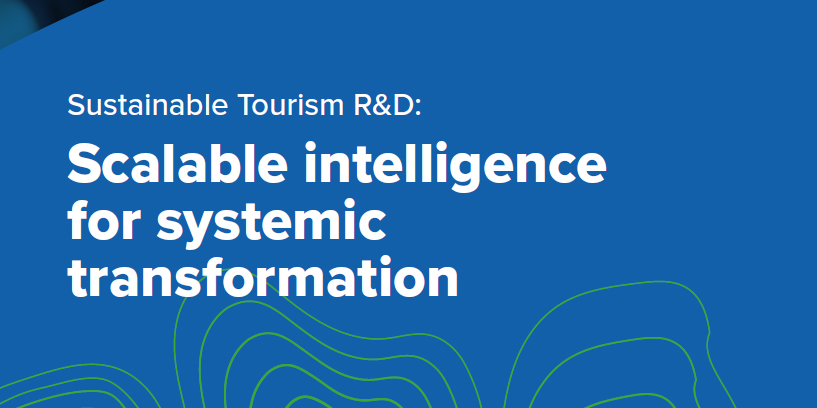
United Nations Development Programme and World Tourism Organization (2026), Sustainable Tourism R&D: Scalable Intelligence for Systemic Transformation, UNDP/UN Tourism, New York/Madrid.
https://www.e-unwto.org/doi/10.18111/9789284427819